Global Market Conditions in 2026 — What Industrial Buyers Must Watch
The global business environment in 2026 is not a normal cycle. It is a structural disruption — driven simultaneously by trade policy, armed conflict, energy volatility, and infrastructure investment surges — that is reshaping steel procurement and asset protection decisions worldwide, including across India.
US Trade Policy: The 50% Steel Tariff Shock
In June 2025, the United States enacted a historic escalation under Section 232, raising duties on imported steel and aluminum to 50%. In April 2026, the Trump administration refined how these tariffs are calculated — applying the full 50% rate to goods made almost entirely of steel, aluminum, or copper. This has rerouted global steel trade flows dramatically. Steel previously destined for the US is being redirected toward Asia and emerging markets — including India — creating pricing pressure and supply complexity for domestic buyers.
For Indian EPC contractors and exporters, this adds a further dimension: supply chains once considered stable are now subject to legal uncertainty, retroactive customs adjustments, and diplomatic renegotiations that affect multi-year project cost models.
The Middle East Conflict: A Supply Chain Shock Without Modern Precedent
The ongoing conflict involving Iran has introduced one of the most severe industrial supply chain disruptions in recent history. The Strait of Hormuz — a critical artery for global energy and commodity flows — has been severely disrupted. Crude oil prices surged approximately 15% in the opening days of the conflict, with some analysts projecting potential peaks near $150 per barrel. Freight war-risk premiums spiked to levels not seen in decades.
For Indian industrial buyers, the downstream consequences are direct. Container prices from India to the Gulf reportedly rose from approximately $300 per container to $3,500 — more than tenfold. Indian steel producers who import nearly 90% of their coking coal requirements via seaborne routes are directly exposed to these disruptions. Higher energy costs, more expensive freight, and tighter raw material availability are compounding across the steel value chain.
Commodity Volatility and Freight Disruption
Iron ore prices have risen by approximately $10 per metric tonne since early March 2026, driven by higher fuel and freight costs. Coking coal prices remain elevated year-on-year. The CRU Global Flat Products Price Indicator stood at 210.9 in April 2026, rising 3% month-on-month, with the Middle East conflict identified as the principal driver. Industrial buyers managing large steel inventories or multi-year infrastructure projects face a clear and compounding risk: replacement costs for unprotected steel are rising faster than project budgets can absorb.
India’s Infrastructure Supercycle — A Demand Multiplier
Counterintuitively, India’s domestic demand story is one of the strongest in the world. India’s steel output grew by over 10.7% year-on-year to approximately 168.4 million tonnes in FY 2025–26. Domestic finished steel consumption expanded by 7–8%, driven by infrastructure, construction, railways, and manufacturing. The Union Budget 2026–27 allocated approximately USD 147 billion to public capital expenditure spanning highways, railways, urban development, and energy infrastructure.
For Maharashtra specifically, the 2026–27 budget identified Pune and the Mumbai Metropolitan Region as priority Growth Hubs — with projects including the Pune Ring Road, Mumbai-Pune High Speed Rail, the Delhi-Mumbai Expressway extension, and Pune Metro Phase II (Rs. 9,857 crore; 31.64 km; approved November 2025). Every major project involves structural steel that must be protected from corrosion for its full lifecycle of 25 to 50 years or more. This intersection — soaring input costs meeting surging infrastructure demand — makes investment in high-quality hot dip galvanizing not just sensible, but financially necessary.
How War and Global Tensions Affect Steel Prices — A Framework for Decision-Makers
Understanding how geopolitical instability transmits into steel markets is essential for procurement heads, project engineers, and plant managers estimating costs over multi-year timeframes.
Before Conflict — Stable Market Conditions
When global markets are stable, the industrial environment is predictable:
- Iron ore and coking coal prices trade within established bands, enabling reliable cost forecasting
- Freight rates are competitive, with shipping lines using efficient routes through major chokepoints
- Energy prices remain moderate, reducing steelmaking input costs significantly
- The Indian rupee is stable, keeping the landed cost of imported coking coal predictable
- Procurement teams can negotiate long-term supply contracts with confidence
Project estimation and lifecycle cost modeling can be executed with high accuracy
During Conflict and High-Tension Periods — The Full Impact Chain
When geopolitical conflict disrupts key global chokepoints, the transmission mechanism is rapid and compounding:
- Crude oil rises sharply as supply routes become uncertain. In the current conflict, Brent crude prices jumped approximately 15% in the opening days alone.Energy Price Spike:
- War-risk insurance premiums surge. Shipping lines reroute, increasing voyage distances, fuel costs, and transit times. Freight costs for industrial cargo rise substantially.Freight Cost Escalation:
- Iron ore and coking coal — the primary inputs for integrated steelmaking — become more expensive to deliver. Indian producers, who import the vast majority of coking coal, are particularly exposed.Raw Material Pressure:
- Rising oil prices weaken the Indian rupee, making coking coal imports (priced in USD) more expensive in local currency. This compounds margin pressure across the domestic supply chain.Currency Volatility:
- Countries redirect surplus steel flows in response to tariffs and access restrictions, creating pricing volatility in Indian markets.Export Disruption:
- Steel prices for fabricators, EPC contractors, and industrial buyers follow input cost inflation upward. Project cost overruns increase and procurement cycles become unpredictable.Downstream Price Increases:
- Procurement teams facing supply uncertainty advance purchases and build buffer stocks, adding short-term demand pressure that further pushes prices upward.Panic Buying:
If Steel Prices Rise, How Does It Affect Hot Dip Galvanizing? The Lifecycle Argument
The answer is counterintuitive to first-order thinking but obvious to experienced industrial decision-makers: when steel becomes more expensive, protecting it properly becomes more critical — not less.
Higher Steel Value Raises the Stakes of Failure
When structural steel was inexpensive, the cost of corrosion-related failure or premature replacement was relatively contained. At today’s elevated prices — driven by freight, tariff, and energy pressures — unprotected steel faces replacement costs that can dwarf the original investment in corrosion protection.
Maintenance Budgets Are Already Under Pressure
In projects where budget overruns from raw material price increases have already tightened operational reserves, the recurring cost of repainting, touch-up maintenance, and corrosion remediation on inadequately protected steel becomes a serious financial and operational burden that compounds over time.
Project ROI Depends on Asset Lifecycle
Whether the project is a solar mounting structure, a transmission tower, a warehousing frame, or a bridge component, the financial return model assumes a certain operational life. Accelerated corrosion — particularly in India’s varied outdoor environments — shortens that life, degrading IRR and increasing total cost of ownership significantly.
Galvanizing as a Lifecycle Cost Decision
The cost of hot dip galvanizing is typically a small percentage of total steel project cost. But its impact on total ownership cost — maintenance, replacement, downtime — is disproportionately large. In a high-steel-price environment, this asymmetry becomes even more pronounced. The real question is not whether you can afford to galvanize. It is whether you can afford not to.
Why Hot Dip Galvanizing Is a Smart Decision During Uncertain Markets
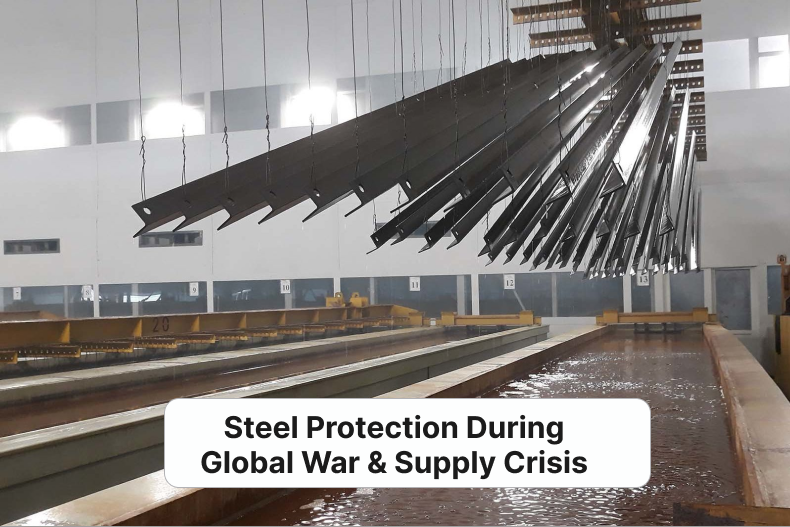
Hot dip galvanizing is a process in which fabricated steel is submerged in molten zinc at approximately 450°C. The zinc metallurgically bonds with the steel surface, forming zinc-iron alloy layers covered by an outer pure zinc layer. The result is a coating that does not sit on top of steel — it becomes part of the steel structure. This process delivers specific, quantifiable benefits that are directly relevant to the current market environment:
- Properly galvanized steel structures routinely achieve 50 to 70 years of maintenance-free corrosion protection in moderate environments — including inland Maharashtra conditions typical of Pune.Proven Long Service Life:
- Unlike paint requiring periodic inspection, surface preparation, and recoating, a galvanized structure needs no maintenance to maintain its protective performance over its full lifecycle.Zero Ongoing Maintenance:
- The immersion process coats all surfaces including interior cavities, sharp edges, and complex geometric angles that painting systems frequently fail to protect — where corrosion most often initiates.Complete Surface Coverage:
- Even if the zinc coating is scratched or damaged, remaining zinc acts as a sacrificial anode, electrochemically protecting exposed steel. Paint systems do not offer this self-healing property.Sacrificial Cathodic Protection:
- On a 25-year total cost basis, hot dip galvanizing consistently delivers a lower cost per year of protection compared to repeated painting cycles — an advantage amplified when labor, downtime, and scaffolding costs are included.Superior Lifecycle Economics:
- Hot dip galvanizing meets IS 2629, IS 4759, ISO 1461, and other key Indian and international standards frequently specified in government and EPC infrastructure tenders. Specification Compliance:
Why Pune Is a Strategic Hub for Hot Dip Galvanizing
Pune occupies a uniquely advantageous position in India’s industrial geography, and that position is becoming more strategically significant as infrastructure investment accelerates across Maharashtra.
Industrial Density and Engineering Base
Pune is home to some of India’s largest automotive OEMs and Tier-1/Tier-2 suppliers, a major IT and engineering services presence, precision engineering firms, and a growing defense manufacturing ecosystem. The volume of fabricated steel components produced and consumed in and around Pune is substantial and growing. For businesses seeking hot dip galvanizing in Pune or centrifugal galvanizing in Pune, proximity to a reliable, quality-certified galvanizing plant is a significant logistical advantage.
Infrastructure Expansion in Pune and Maharashtra
The Mumbai-Pune High Speed Rail corridor, Pune Ring Road, Pune Metro Phase II, the Delhi-Mumbai Expressway extension, and multiple logistics and warehousing parks across the Pune-Mumbai-Nashik industrial triangle all require large quantities of galvanized structural steel. Maharashtra’s Maharashtra Budget 2026–27 allocates Rs. 12.21 lakh crore to infrastructure, identifying Pune as a Growth Hub. These projects generate sustained demand for hot dip galvanizing in Maharashtra.
Solar and Renewable Energy Expansion
Maharashtra is a major destination for utility-scale solar installations. Solar mounting structures installed in outdoor environments for 25-year project lifetimes make hot dip galvanizing the standard — and often specification-mandated — choice. Industrial buyers seeking hot dip galvanizing in Mumbai and across the state benefit from Pune’s central position within this supply chain.
Proximity to Mumbai’s Industrial Demand
The Pune-Mumbai corridor functions as an integrated industrial zone for steel fabrication and treatment services. Galvanized components produced in Pune efficiently serve projects across the Mumbai Metropolitan Region — one of Asia’s highest-value infrastructure investment zones. For buyers sourcing hot dip galvanizing in India, this geographic advantage translates directly into shorter lead times and lower logistics cost.
Why Choose Galcons India — Your Trusted Galvanizing Partner
Galcons India is a Pune-based provider of hot dip galvanizing services, serving industrial clients across Pune, Mumbai, Maharashtra, and India. Our positioning is straightforward: we deliver quality-consistent, reliable, technically capable galvanizing solutions to industrial buyers who understand the long-term value of protecting their steel assets correctly.
Our plant operates to established process controls for bath chemistry, immersion temperature, withdrawal speed, and flux management. Coating thickness is monitored and documented to IS and ISO standards, providing certifiable quality evidence. Quality-Focused Process:
Industrial buyers working on government infrastructure tenders or EPC contracts need a galvanizer who delivers consistent results batch after batch — not just on a selected showcase run. Our process discipline is designed for volume production quality.Consistent Coating Standards:
We manage production scheduling to meet committed turnaround windows, supporting fabricators and contractors managing downstream installation programs. Reliable Turnaround Times:
From small fasteners and brackets through centrifugal galvanizing to large structural sections, our facility handles the diversity of requirements that industrial projects generate.Industrial Project Capability:
For small parts — fasteners, bolts, nuts, brackets, clips — centrifugal (spin) galvanizing provides uniform coating distribution with precise dimensional control. A specialist service for high-volume small-part requirements.Centrifugal Galvanizing in Pune:
While our primary plant is based in Pune — efficiently serving the Pune-Mumbai-Maharashtra corridor — our logistics partnerships support project requirements across India.Pan-India Service Capability:
We work with procurement heads, project engineers, and quality managers to understand specification requirements, production schedules, and quality documentation needs before committing to a contract.
Industries We Serve
| Industry | Key Applications |
|---|---|
| Transmission & Power | Tower structures, cross-arms, hardware, earthing assemblies, substations |
| Solar & Renewable Energy | Mounting structures, frames, tracker systems, fencing, balance-of-system |
| Telecom Infrastructure | Mobile tower structures, antennae mounts, equipment enclosures, masts |
| Automotive & Engineering | Chassis parts, brackets, sub-frames, agricultural equipment components |
| Infrastructure & Roads | Guard rails, sign gantries, bridge components, drainage covers, culverts |
| Construction & Real Estate | Structural sections, purlins, roof sheeting, railings, staircases, lintels |
| Warehousing & Logistics | Rack systems, mezzanine floors, dock equipment, shelving, pallet frames |
| Agriculture Equipment | Irrigation fittings, pump components, farm implements, sprinkler systems |
| Rail & Infrastructure | Bridge components, platform canopies, signal gantries, station structures |
| Export Components | Fabricated steel for international projects meeting global galvanizing standards |
Cost vs Value — Why Procurement Decisions Must Go Beyond Initial Price
In tightening market conditions, the instinct of many procurement teams is to optimize for the lowest upfront cost. This is understandable. In the context of corrosion protection, it is also an expensive mistake.
Initial Savings Are Small; Failure Costs Are Large
The price difference between inadequate surface treatment and properly applied hot dip galvanizing is typically a fraction of total project cost. However, premature corrosion failure can require full structural replacement — at today’s elevated steel prices — within 10 to 15 years instead of 50 to 70 years. The financial arithmetic is straightforward: the savings captured upfront are consumed many times over in replacement cost.
Maintenance Shutdown Costs Are Disproportionate
For a solar farm, transmission network, or logistics facility, a corrosion-related structural inspection, remediation program, or forced shutdown involves costs that dwarf any initial coating saving. Beyond direct repair costs, production losses, contract penalties, and liability exposure multiply the financial damage.
Total Ownership Cost Is What Matters
Sophisticated industrial buyers — EPCs, government infrastructure agencies, and institutional asset owners — evaluate corrosion protection on total cost of ownership. Hot dip galvanizing consistently delivers superior value in this framework. The question for decision-makers is not what galvanizing costs today. It is what failure to galvanize will cost over the life of the asset.
The table below summarizes the economic case clearly:
| Factor | Without Galvanizing | With Hot Dip Galvanizing |
|---|---|---|
| Steel Price Increase Impact | High replacement risk; rising costs amplify exposure | Extended steel life; higher prices make protection more valuable |
| Maintenance Cost (25-year basis) | Repeated repainting, surface prep, labor, & access equipment | Negligible — galvanized steel needs zero routine maintenance |
| Outdoor Corrosion Resistance | Rapid degradation in humid, coastal, or industrial environments | 50–70+ yr protection; self-healing cathodic action at damage points |
| Energy/Freight Volatility Exposure | Replacement procurement exposed to further price escalation | Lifecycle extension avoids re-procurement at elevated market prices |
| Lifecycle ROI | Weak — rising input costs compress already-thin project margins | Strong — asset protection locks in value of original investment |
| Tender Compliance | Potential specification gaps; risk of quality disputes | Meets IS 2629 / IS 4759 / ISO 1461 with documented coating records |
| Maharashtra Climate Suitability | Accelerated corrosion in monsoon humidity & coastal zones | Proven zinc performance; highly suited to India's outdoor conditions |
Frequently Asked Questions
Q1: What is hot dip galvanizing?
Hot dip galvanizing is an industrial process in which fabricated steel or iron is submerged in molten zinc at approximately 450°C. The zinc metallurgically bonds with the steel surface, forming zinc-iron alloy layers that provide long-term corrosion protection. Unlike paint, hot dip galvanizing becomes part of the steel structure, providing cathodic protection even when mechanically damaged.
Q2: How long does hot dip galvanizing last?
In moderate inland environments typical of Pune and Maharashtra, properly galvanized steel structures achieve 50 to 70+ years of maintenance-free corrosion protection. In coastal or industrial environments, typical service life is 25 to 40 years with no routine maintenance required.
Q3: Why does rising steel price make galvanizing more important?
When structural steel becomes more expensive, the financial cost of premature corrosion failure or replacement increases proportionally. Protecting a higher-value asset against corrosion is smart asset management. Hot dip galvanizing extends the useful life of expensive steel and avoids replacement costs.
Q4: Is hot dip galvanizing worth it when steel prices are high?
Yes. The cost of galvanizing is usually a small fraction of total steel project value, but it significantly reduces lifecycle costs. Replacing inadequately protected steel is far more expensive than a one-time galvanizing investment.
Q5: What is centrifugal galvanizing and how does it differ?
Centrifugal galvanizing (spin galvanizing) is used for small components such as bolts, nuts, brackets, and clips. After dipping in molten zinc, parts are spun in a centrifuge to remove excess zinc and ensure even coating.
Q6: Why choose hot dip galvanizing in Pune specifically?
Choosing a Pune-based galvanizing partner offers lower transport costs, faster turnaround, easier quality checks, and better support for projects in Pune, Mumbai, and Maharashtra.
Q7: How is hot dip galvanizing better than paint?
Paint provides only barrier protection and can fail when scratched or chipped. Hot dip galvanizing offers both barrier and cathodic protection, protecting exposed steel even at damaged points. It also requires far less maintenance over time.
Q8: Does Galcons India serve projects outside Pune?
Yes. While based in Pune, Galcons India serves clients across Mumbai, Maharashtra, and pan-India through logistics partnerships for collection and delivery of fabricated components.