
What if a simple design oversight could compromise coating quality, create safety risks, or lead to costly rework after fabrication is complete?
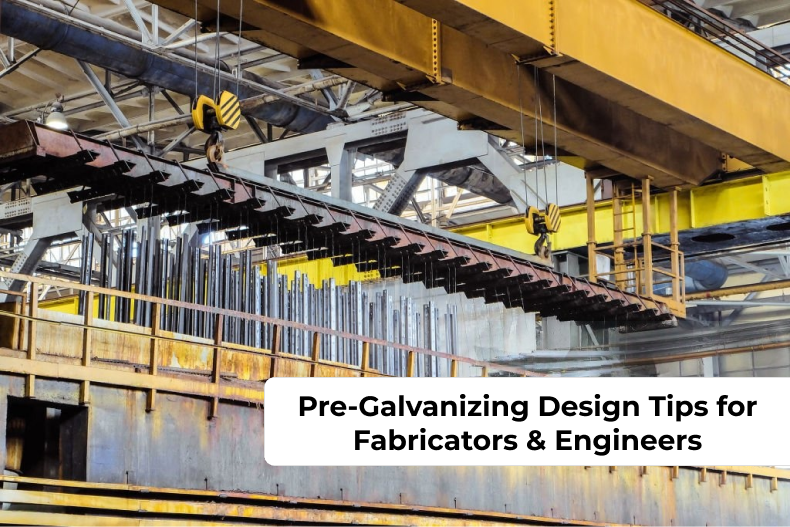
Hot-dip galvanizing is not just a finishing step, it is a high-temperature, full-immersion metallurgical process that must be anticipated during the design phase. When fabricators and engineers treat galvanizing as an afterthought, issues such as trapped air, poor drainage, distortion, uneven coating thickness, or incomplete coverage can arise.
These challenges not only impact corrosion protection but can also delay projects and increase costs.
Designing steel with galvanizing in mind ensures smoother processing, safer immersion, consistent coating performance, and long-term durability. From vent hole placement and material selection to tolerance allowances and fabrication symmetry, small design decisions have a significant impact on final results.
For fabricators and engineers, pre-galvanizing planning is not an added step, it is a strategic safeguard that protects structural integrity, compliance, and lifecycle performance.
Why Design Planning Is Critical Before Galvanizing
Hot-dip galvanizing exposes fabricated steel to molten zinc at approximately 450°C. At this temperature, the process is not merely coating the surface, it is triggering a metallurgical reaction between zinc and iron. Because of this, the geometry, fabrication method, and material selection directly influence the final outcome.
If components are not properly designed for immersion, several issues can arise. Air pockets may prevent zinc from reaching internal surfaces. Poor drainage can lead to excess zinc accumulation. Sealed cavities can create dangerous pressure build-up during processing. Asymmetrical sections may experience thermal stress and distortion.
Unlike paint systems, galvanizing cannot simply be “touched up” to fix design flaws. The process depends on unrestricted zinc flow, proper venting, and structural balance. That means design decisions made at the drafting table directly affect coating completeness, safety, dimensional stability, and long-term corrosion performance.
For fabricators and engineers, early design coordination is not optional, it is essential to ensure efficient processing, regulatory compliance, and durable protection.
Proper Venting and Drainage Design
Venting and drainage are among the most critical design considerations before galvanizing. Because hot-dip galvanizing is a full-immersion process, molten zinc must be able to flow freely into, through, and out of hollow or fabricated sections.
Without properly placed vent and drain holes, air can become trapped inside sealed or semi-sealed components. This prevents zinc from fully coating internal surfaces and can create dangerous pressure build-up during immersion. In extreme cases, trapped air or moisture may lead to safety hazards during processing.
Effective venting ensures:
- Complete internal coating coverage
- Safe release of air and gases
- Uniform heating during immersion
- Excess zinc can flow out smoothly
- Reduced zinc pooling at low points
- Consistent coating thickness
- Improved surface finish
Material Selection and Steel Chemistry Considerations
Not all steel reacts the same way during hot-dip galvanizing. The chemical composition of the steel, particularly silicon and phosphorus content, plays a major role in determining coating thickness, appearance, and overall finish quality.
When steel is immersed in molten zinc, a metallurgical bond forms through a controlled reaction between iron and zinc. However, higher silicon or phosphorus levels can accelerate this reaction, leading to thicker coatings and sometimes a darker or matte-gray finish. While thicker coatings can enhance corrosion protection, they may affect aesthetics or dimensional tolerances in precision components.
This is commonly referred to as the “Sandelin effect,” where certain silicon ranges cause rapid coating growth. Engineers and fabricators should review mill certificates and confirm steel chemistry when coating consistency or appearance is critical.
Material selection impacts:
- Coating thickness control
- Surface appearance and uniformity
- Adherence to dimensional tolerances
- Overall lifecycle performance
Managing Distortion and Thermal Stress
Hot-dip galvanizing involves immersing steel in molten zinc at high temperatures, which means every component undergoes rapid heating and cooling. While steel is structurally strong, uneven thickness, asymmetrical fabrication, or residual welding stresses can increase the risk of distortion during the process.
Thin sections heat faster than thicker ones. If a fabrication combines heavy plates with lighter components, differential expansion may occur. Similarly, long, unsupported spans or poorly balanced assemblies can shift slightly under thermal stress. In most cases, distortion is minor and correctable, but good design reduces the risk significantly.
Welding practices also influence distortion. Over-welding, uneven weld distribution, or high residual stress areas can cause movement when exposed to galvanizing temperatures. Balanced welds and controlled fabrication techniques help maintain dimensional stability.
To minimize distortion risk:
- Maintain uniform material thickness where possible
- Avoid mixing extremely thick and thin sections in one assembly
- Design symmetrical structures when feasible
- Use balanced, consistent welding practices
Designing for Assembly Size and Handling
Hot-dip galvanizing requires full immersion of fabricated components into a galvanizing kettle. That means the overall size, weight, and configuration of assemblies must align with plant capabilities and safe handling practices.
Oversized fabrications that exceed kettle dimensions may require double-dipping (immersing one end at a time), which can create visible overlap lines and may affect coating uniformity. While this method is effective when planned correctly, it should be considered during the design phase to avoid aesthetic or structural concerns later.
Weight distribution is equally important. Uneven or unstable assemblies can shift during lifting, affecting coating consistency or posing safety risks. Lifting points should be strategically designed to ensure safe and stable movement throughout the galvanizing process.
Engineers and fabricators should account for:
- Maximum kettle size limitations
- Component weight and lifting balance
- Structural stability during immersion
- Accessibility for hooks or lifting fixtures
Surface Preparation and Fabrication Cleanliness
Successful galvanizing depends heavily on proper surface preparation. Before immersion in molten zinc, steel passes through a series of cleaning stages to remove oil, grease, mill scale, and oxides. However, certain fabrication choices can interfere with this process if not addressed early.
Contaminants such as heavy paint markings, welding slag, cutting oils, silicone sealants, adhesives, or excessive anti-spatter sprays can prevent proper cleaning. When residues remain on the surface, zinc cannot bond correctly, resulting in bare spots or coating irregularities.
Design and fabrication teams should also avoid creating tight overlapping surfaces or sealed lap joints where cleaning solutions cannot penetrate. These areas may trap chemicals or remain uncleaned, leading to coating defects or long-term corrosion risks.
To support optimal coating performance:
- Ensure welds are smooth and slag-free
- Remove oils, grease, and marking compounds before dispatch
- Avoid sealed overlaps without proper venting
- Coordinate surface preparation expectations with the galvanizer
How Galcons India Supports Fabricators & Engineers
Designing for hot-dip galvanizing becomes significantly easier when you collaborate with an experienced galvanizing partner early in the project lifecycle. Galcons India works closely with fabricators, structural consultants, and engineers to ensure every component is optimized before it reaches the galvanizing bath.
From reviewing fabrication drawings to advising on venting, drainage, steel chemistry, and assembly sizing, their technical team helps identify potential risks before production begins. This proactive approach minimizes coating defects, reduces rework, and prevents costly site-level corrections.
Galcons India also supports clients by:
- Providing pre-galvanizing design consultation
- Verifying kettle size compatibility and handling feasibility
- Recommending best practices for distortion control
- Guiding material selection for predictable coating results
- Ensuring compliance with relevant IS and international galvanizing standards
Conclusion
Pre galvanizing design is a critical step in ensuring that steel structures achieve their intended lifespan and corrosion protection performance. By integrating galvanizing design guidelines into fabrication and engineering workflows, professionals can improve coating quality, reduce rework, and enhance structural durability.
If you’re designing steel components for galvanizing, consider speaking with a technical expert to review your drawings or download a pre-galvanizing design checklist to help streamline your project planning.
Partner with Galcons India to ensure your steel structures are engineered for maximum durability, safety, and long-term corrosion protection. From pre-fabrication design guidance to precision hot-dip galvanizing, our experts are here to support your project at every stage.
Connect with our technical team today and build stronger, longer-lasting structures with confidence.