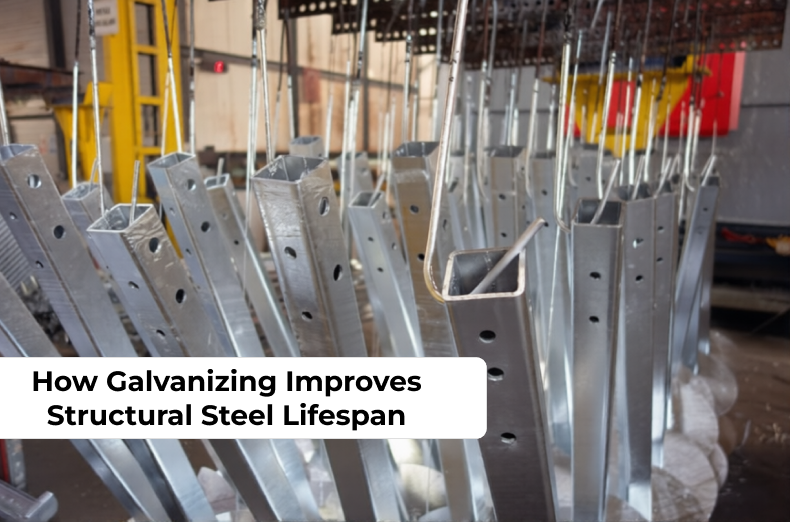

Structural steel is widely used in infrastructure, buildings, bridges, towers, and industrial facilities because of its strength and versatility. However, steel is vulnerable to corrosion when exposed to moisture, chemicals, and environmental pollutants. Corrosion can reduce load-bearing capacity, increase maintenance costs, and shorten the service life of structures. One widely used method to extend galvanized steel lifespan is hot dip galvanizing (HDG). Leading providers such as Galcons India deliver high-quality hot dip galvanizing solutions that apply a protective zinc coating acting as both a physical barrier and a sacrificial layer, significantly slowing corrosion and enhancing durability in demanding environments. This article explains how galvanizing works, how it compares to other protection methods, relevant standards, and key benefits and limitations to help you evaluate whether it is the right solution for your application.
What Is Hot Dip Galvanizing?
- Barrier protection: Zinc isolates steel from moisture and oxygen.
- Cathodic (sacrificial) protection: Zinc corrodes preferentially, protecting exposed steel if the coating is damaged.
How Galvanizing Extends Structural Steel Lifespan
Factors That Influence Galvanized Steel Lifespan
- Zinc coating thickness: Thicker coatings provide longer protection.
- Environmentalexposure: Rural, urban, marine, and industrial environments affect corrosion rates differently.
- Design and drainage: Proper drainage reduces trapped moisture and corrosion risk.
- Steel composition: Silicon and phosphorus levels can affect coating thickness and appearance.
Galvanizing vs Other Corrosion Protection Methods
| Factor | Hot Dip Galvanizing | Paint Coating |
|---|---|---|
| Bonding | Metallurgical bond | Mechanical adhesion |
| Maintenance | Low | Moderate to high |
| Scratch Protection | Sacrificial protection | No self-healing |
| Application | Factory process | On-site or factory |
| Lifespan | Long-term | Short to medium-term |
Hot Dip Galvanizing vs Metallizing (Thermal Spray Zinc)
- Galvanizing: Uniform coating, excellent coverage inside and out, controlled factory process.
- Metallizing: Useful for large structures or on-site work, but bond strength is typically lower than HDG.
Duplex Systems (Galvanizing + Paint)
Combining galvanizing with a paint system can significantly extend corrosion resistance, especially in aggressive environments such as coastal or industrial zones.Relevant Technical Standards and Specifications
Hot dip galvanizing is governed by several international standards that define coating thickness, inspection criteria, and quality requirements:
ASTM Standards
- ASTM A123/A123M: Specification for zinc coatings on iron and steel products
- ASTM A153/A153M: Zinc coating for hardware
- ASTM A780: Repair of damaged galvanized coatings
ISO Standards
- ISO 1461: Hot dip galvanized coatings on fabricated iron and steel articles
- ISO 14713: Guidelines for zinc coatings and corrosion protection
These standards help engineers and specifiers ensure consistent quality and predictable performance.
Benefits of Hot Dip Galvanizing
- Long-Term Corrosion Protection Galvanized coatings provide durable protection in many environments, reducing lifecycle costs.
- Complete Coverage Immersion ensures coating on edges, corners, and internal surfaces—areas where paint often fails.
- Low Maintenance Once installed, galvanized steel often requires minimal inspection and maintenance.
- Predictable Performance Coating thickness standards allow engineers to estimate service life with reasonable accuracy.
- Sustainability Zinc is recyclable, and galvanized steel structures often have longer service intervals, reducing material replacement.
Limitations and Considerations
- Size limitations: Large structures may exceed kettle dimensions.
- High-temperature environments: Zinc coatings may degrade at elevated temperatures.
- Aesthetic requirements: Coating appearance can vary depending on steel chemistry.
- Initial fabrication planning: Drainage and venting holes must be designed into hollow sections.
Common Misconceptions About Galvanized Steel
“Galvanized steel never rusts”
Galvanizing significantly delays corrosion, but zinc will eventually be consumed depending on exposure conditions.“Paint is always cheaper”
Initial costs may be lower, but lifecycle costs often favor galvanizing due to reduced maintenance.“Galvanizing weakens steel”
The process does not significantly affect structural steel mechanical properties when properly specified.“All galvanized coatings are the same”
Coating thickness and quality vary based on standards, steel chemistry, and process control.When to Consider Hot Dip Galvanizing
- Structural beams and columns
- Transmission towers
- Bridges and rail infrastructure
- Industrial platforms and walkways
- Agricultural structures
- Outdoor architectural steel
Conclusion
Hot dip galvanizing remains one of the most reliable and cost-effective solutions for extending the lifespan of structural steel in demanding environments. By providing both barrier and sacrificial protection, it significantly reduces corrosion risk, lowers lifecycle maintenance costs, and delivers predictable long-term performance when designed and specified correctly. For infrastructure developers, EPC contractors, fabricators, and project consultants, selecting the right galvanizing partner is just as important as selecting the right coating system. Galcons India stands out as a trusted provider of professional hot dip galvanizing services, delivering consistent coating quality, adherence to international standards, and dependable turnaround times for critical projects. With strong process control, technical expertise, and a commitment to durability and sustainability, Galcons India helps ensure that structural steel components achieve maximum service life with minimal maintenance. When long-term corrosion protection, compliance, and reliability matter, partnering with Galcons India provides the confidence and performance modern infrastructure demands.