How to Choose the Right Hot Dip Galvanizing Service Provider
Choosing the right hot dip galvanizing service provider requires evaluating IS 2629 / ISO 1461 certifications, zinc bath capacity, surface preparation standards, coating thickness documentation, turnaround time, and industry references. A certified local galvanizing plant with a proven track record reduces logistics cost, improves quality oversight, and ensures your steel meets project specifications.
Introduction
Galvanizing decisions made at procurement determine whether a project delivers on its design life — or starts deteriorating within years. Choosing the wrong vendor leads to coating failures, rejected material, and project delays. Choosing the right one means your steel structures perform for 40–70 years without maintenance.
For procurement managers, EPC contractors, and fabricators across Pune, Maharashtra, and India, this guide provides a clear framework for selecting the best galvanizing service partner.
Importance of Hot Dip Galvanizing in Modern Industries
Hot dip galvanizing is not a commodity service. The quality of zinc coating applied to structural steel determines corrosion resistance and service life on bridges, towers, industrial buildings, and solar mounting systems.
A galvanizing plant that cuts corners on surface preparation, zinc purity, or bath temperature can produce steel that fails within two to three years — regardless of the original steel quality. Vendor selection is as critical as specifying the right steel grade.
Benefits of Galvanizing for Steel Protection
When executed correctly, quality galvanizing delivers:
- 50+ year service life in most industrial environments
- Cathodic protection that self-sacrifices to protect steel at scratches
- Complete surface coverage on all geometries
- Zero maintenance for decades
- Compliance with project lender and regulatory requirements
These benefits are only achieved with the right vendor.
Key Factors to Evaluate When Choosing a Galvanizing Service Provider
1. Certifications and Standards Compliance
The starting point is IS 2629 (Indian Standard) or ISO 1461 (international standard) compliance. Always request:
- Written compliance documentation
- Test certificates from recent jobs
- ISO 9001 quality management certification (positive indicator of process discipline)
2. Zinc Bath Capacity and Steel Size Capability
Confirm the vendor’s bath dimensions (length × width × depth) accommodate your largest steel sections. Vendors who cannot process your section size will require inconvenient sub-contracting — introducing quality and cost risks.
3. Surface Preparation Quality
Galvanizing quality depends heavily on degreasing, pickling, fluxing, and drying before the steel enters the zinc bath. Ask to see the surface preparation line. Poorly managed pickling or flux baths produce bare spots, poor adhesion, and coating failures.
4. Zinc Metal Quality
SHG (Special High Grade) zinc — 99.99% purity — is the standard. Ask your vendor:
- What zinc grade do you use?
- Are bath composition records maintained? Lower-grade zinc produces dull, rough coatings with reduced corrosion resistance.
5. Turnaround Time
Infrastructure projects run on tight schedules. Confirm:
- Standard lead time commitment in writing
- Availability of priority processing for urgent batches
- Production scheduling transparency
6. Centrifugal Galvanizing Capability
If your project includes fasteners, clips, or hardware, confirm centrifugal (spin) galvanizing is available in-house. Splitting your order across multiple vendors adds cost and coordination complexity.
7. Technical Support
A quality galvanizing partner advises on:
- Vent hole placement in hollow sections
- Drainage hole positioning
- Steel chemistry concerns before processing Proactive technical input prevents costly redesigns downstream.
8. Transparent Pricing and Documentation
Ask vendors to break down pricing clearly: base rate, handling, transport, centrifugal premium, and documentation charges. Ambiguous pricing structures signal poor commercial management.
Impact of Quality Coating on Infrastructure Durability
Poor galvanizing — thin coatings, bare spots, flux inclusions — creates corrosion initiation points that are sometimes impossible to remediate after installation. Quality galvanizing from a properly evaluated vendor ensures the corrosion protection investment lasts the full project life.
Why Indian Industries Need Reliable Galvanizing Partners
India’s infrastructure sector is scaling fast, and galvanizing quality requirements are becoming more stringent — driven by PSU specifications, international developer standards, and project lender due diligence. Reliable, certified galvanizing partners are increasingly critical.
Why Businesses Prefer Local Galvanizing Services
A local galvanizing plant in Pune offers:
- Lower freight cost for heavy structural steel
- Faster turnaround — less transit time on both legs
- Direct quality oversight — easier plant visits and batch inspection
- Faster problem resolution — no remote communication delays
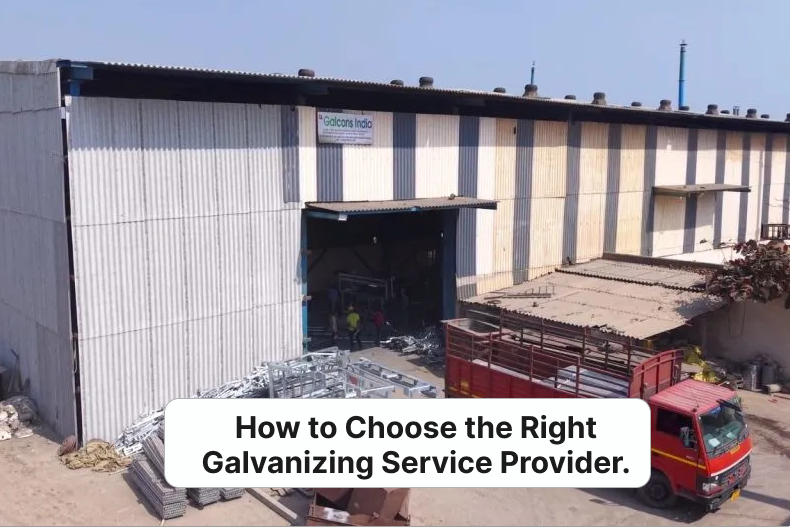
For projects across Pune and Maharashtra, Galcons India’s local presence is a genuine competitive advantage.
Why Choose Galcons India
- IS 2629 / ISO 1461 compliant operations
- High-capacity zinc bath for large structural sections
- Centrifugal galvanizing for small parts and hardware
- Full batch documentation — test certificates and galvanizing certificates
- Transparent, competitive pricing
- Serving Pune, Mumbai, Maharashtra, and India
Industries Served
EPC contractors, solar structure manufacturers, structural fabricators, automotive component manufacturers, telecom and power transmission companies, highway and railway contractors.
Future Trends in Corrosion Protection
The Indian galvanizing industry is moving toward automated quality measurement, digital reporting, and environmental compliance upgrades. Future-ready vendors are already investing in real-time production tracking and expanded capacity to serve India’s growing infrastructure pipeline.