Hot Dip Galvanizing vs Painting: Which Offers Better Long-Term Protection?
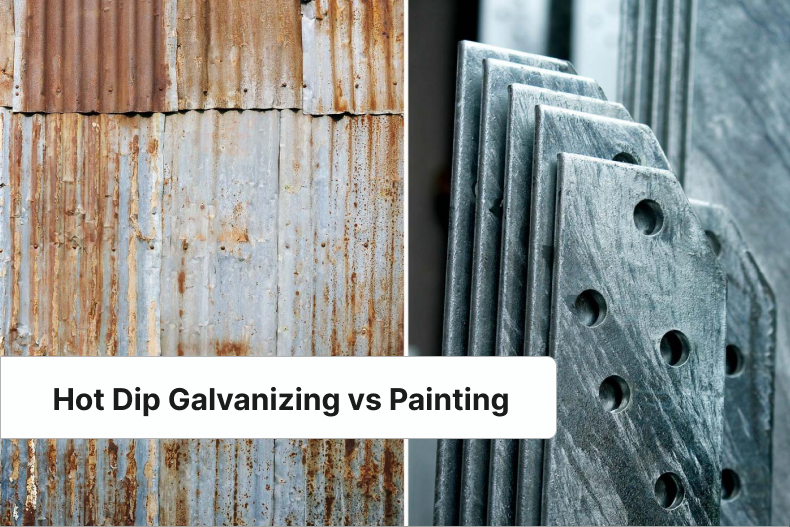
Hot dip galvanizing and painting are two common steel corrosion protection methods. Galvanizing bonds zinc metallurgically to steel, lasting 50+ years with zero maintenance. Painting requires recoating every 5–10 years. For infrastructure, industrial, and outdoor steel applications, hot dip galvanizing consistently delivers superior durability and lower lifecycle cost than painting.
Steel is the backbone of India’s infrastructure — from highways and bridges to solar farms and industrial plants. But without proper corrosion protection, even the strongest structural steel can fail within years of installation.
Two of the most widely used protection methods are hot dip galvanizing and painting. On the surface, both seem like straightforward options. But when you evaluate them over a 20-, 30-, or 50-year project lifecycle, the differences become stark — in terms of durability, maintenance cost, environmental impact, and total return on investment.
For EPC contractors, fabricators, and infrastructure companies operating across Pune, Maharashtra, and India, choosing the right protection method is not just a technical decision — it is a financial one. This guide breaks down the comparison in full detail so you can make the most informed choice for your next project.
Importance of Hot Dip Galvanizing in Modern Industries
Why Corrosion Protection Cannot Be an Afterthought
Steel corrosion costs India billions of rupees every year in maintenance, replacement, and structural failures. According to global industry studies, corrosion accounts for roughly 3–4% of a country’s GDP in losses annually. For a growing economy like India — with massive investments in railways, highways, energy, and urban infrastructure — the stakes could not be higher.
Hot dip galvanizing has emerged as the preferred corrosion protection method for critical steel structures precisely because it eliminates these risks at the source. By creating a zinc-iron alloy barrier that bonds at a molecular level with the steel substrate, galvanizing does not merely sit on the surface — it becomes part of the steel itself.
The Industrial Shift Toward Galvanizing
Industries across India are increasingly mandating galvanized steel in project specifications. Public sector undertakings (PSUs), the National Highways Authority of India (NHAI), Indian Railways, and major solar developers now specify hot dip galvanizing as a standard requirement for structural steel. This reflects a broader recognition that galvanized steel simply outperforms painted steel in real-world conditions.
Hot Dip Galvanizing vs Painting: The Core Differences
What Is Hot Dip Galvanizing?
Hot dip galvanizing is a process in which prepared steel is immersed in a bath of molten zinc at approximately 450°C. The zinc reacts with the steel to form a series of zinc-iron alloy layers, topped by an outer pure zinc layer. The result is a coating that:
- Bonds metallurgically with the steel (not just adhesive)
- Covers all surfaces, including recesses, threads, and interior cavities
- Provides cathodic (sacrificial) protection — meaning zinc protects the steel even if the coating is scratched
- Requires no touch-up or maintenance for decades
What Is Painting?
Industrial painting involves applying one or more layers of protective paint, primer, or epoxy coating to the steel surface. Paint acts as a barrier coating — it keeps moisture and oxygen away from the steel. When the paint film is intact, it performs adequately. But:
- Paint does not bond metallurgically with steel
- Any damage to the paint surface — scratches, chips, abrasion — allows moisture to reach the steel and triggers localized corrosion
- Painted structures require inspection and recoating every 5–10 years
- Paint cannot protect internal surfaces, bolt holes, or complex geometries as effectively
Benefits of Galvanizing for Steel Protection
1. Unmatched Longevity
Hot dip galvanizing provides 50 to 70 years of corrosion protection in most industrial environments — and over 100 years in rural or sheltered environments. Painted steel typically requires its first major recoat within 5–7 years in Indian coastal or industrial environments, and full replacement within 15–20 years if maintenance is deferred.
2. Cathodic (Sacrificial) Protection
This is galvanizing’s most unique advantage. Because zinc is electrochemically more active than steel, it preferentially corrodes in the presence of moisture and oxygen — protecting the underlying steel even through small gaps or scratches. No paint system offers this self-sacrificing protection.
3. Complete Surface Coverage
The immersion process ensures that zinc reaches every surface — internal welds, edges, threads, corners, and hidden cavities. Painting, by contrast, often misses edges, corners, and internal surfaces, leaving weak points that corrode first.
4. Zero Maintenance for Decades
Once galvanized, a steel structure typically requires no maintenance for 20–40 years in industrial environments. Painted structures require regular inspection, touch-up, and recoating — generating ongoing labor, material, and project downtime costs.
5. Superior Impact and Abrasion Resistance
Galvanized coatings are significantly harder than paint films. They resist mechanical damage from transportation, installation, and service loading far better than painted surfaces.
Impact of Quality Coating on Infrastructure Durability
Real-World Infrastructure Performance
India’s infrastructure projects — bridges, flyovers, transmission towers, railway structures, and industrial buildings — face some of the most demanding corrosion environments in the world. Coastal humidity, monsoon rains, industrial pollutants, and extreme temperature cycles all accelerate steel deterioration.
Structures protected with quality hot dip galvanizing consistently outlast painted counterparts by 3–5 times in real-world infrastructure deployments. This means:
- Fewer structural replacements over a project’s life
- Reduced maintenance budgets
- Greater safety reliability
- Lower lifecycle cost
The Hidden Cost of Painting
When comparing galvanizing and painting costs, many project managers focus on the upfront price per kilogram. Painting often appears cheaper initially. But this comparison ignores:
- Recoating every 7–10 years
- Scaffolding, surface preparation, and labor for each recoating cycle
- Project shutdowns during maintenance
- Early replacement if maintenance is delayed
- Safety risks from deteriorating coatings on structural members
Over a 40-year lifecycle, hot dip galvanized steel consistently delivers 30–50% lower total cost than painted steel in comparable environments.
Why Indian Industries Need Reliable Galvanizing Partners
The Specification Gap in India
A significant challenge in Indian infrastructure projects is the inconsistent specification and enforcement of corrosion protection standards. Projects that specify galvanizing but accept substandard work — or switch to paint to cut upfront costs — routinely face early failures and costly remediation.
Working with a certified, standards-compliant galvanizing partner eliminates this risk. ISO 1461-compliant galvanizing, proper surface preparation, and quality zinc ensures that the protective coating performs as specified.
Why Galvanizing Decisions Are Made Early
The best time to plan for galvanizing is at the design and fabrication stage. Design features like vent holes, drainage points, and accessible surfaces make a significant difference in galvanizing quality. EPC contractors and fabricators who engage their galvanizing partner early avoid costly rework and specification failures downstream.
Pune's Growth as a Hot Dip Galvanizing Hub
Why Businesses Prefer Local Galvanizing Services
Pune has emerged as one of Maharashtra’s most important industrial zones, with a high concentration of engineering manufacturers, auto ancillaries, EPC contractors, and infrastructure companies. The growth of solar power projects, transmission infrastructure, road projects, and industrial construction in Pune and its surrounding districts has driven significant demand for professional hot dip galvanizing services.
Galvanizing plants in Pune serve customers across Maharashtra and beyond — processing structural steel, solar mounting systems, telecom towers, highway guardrails, pre-engineered building components, and industrial equipment. Local galvanizing reduces transportation cost, turnaround time, and project logistics complexity — major advantages for time-sensitive infrastructure projects.
Faster Turnaround, Lower Logistics Cost
Shipping heavy structural steel to distant galvanizing plants adds cost, handling risk, and time to every project. Local galvanizing services in Pune allow contractors and fabricators to reduce:
- Transportation cost (per-tonne freight)
- Transit damage risk for fabricated steel
- Turnaround time from fabrication to galvanized delivery
- Coordination complexity across project timelines
Better Communication and Quality Oversight
Working with a local galvanizing partner allows project teams to visit the plant, inspect in-process quality, and resolve specification questions in real time. Remote galvanizing relationships often result in communication delays and quality disputes that are difficult to resolve once material is in transit.